
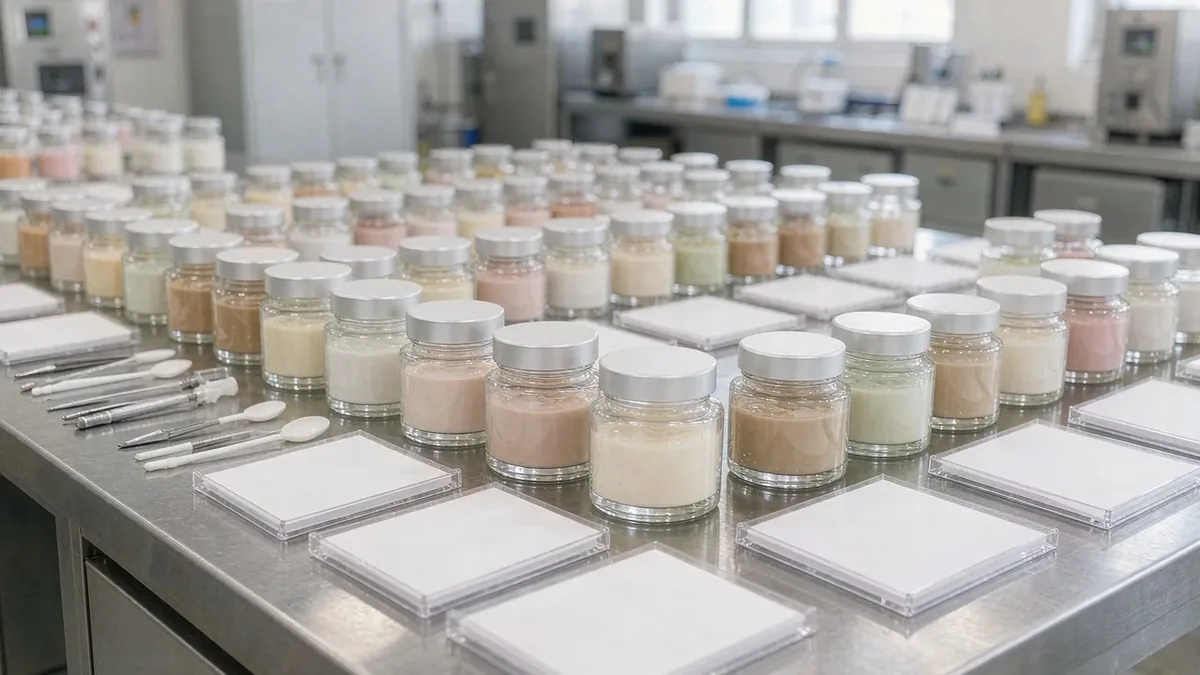
Sample Management: Development, Retention and Stability Samples
Between the bench and the shipped pallet there are several kinds of sample, and they are frequently confused with one another. Each has a different purpose, a different storage rule and a different retention period. Getting them mixed up leads to a plant that keeps plenty of physical material and still cannot answer a question about a specific batch.
The Categories
- Development and bench samples. The formulation work, including trial variants, iteration on texture and fragrance, and the approved reference sample the brand signed off. These are the record of what was agreed.
- Pilot samples. Produced in production-representative equipment, used for scale-up decisions, compatibility work and early stability. The pilot sample is often the true reference for what the product will be, more so than the bench sample.
- Marketing and pre-production samples. Produced for photography, retailer presentations and consumer panels. Useful, but they are not batch references.
- Stability samples. Drawn from development or production batches and placed on a defined storage programme, tested at defined intervals to generate the shelf life data.
- Retention samples. Drawn from every production batch and stored for the life of that batch, to be available if a question arises.
Retention Samples: The Rule
Every production batch should have a retention sample. The conventional requirement is a retained quantity sufficient to perform the specified tests at least twice, kept in the final pack or in a pack equivalent to it, stored under the conditions stated on the label, and retained for the shelf life of the product plus a margin. The margin exists because complaints and questions arrive at the end of shelf life, not in the first month.
Storing in the final pack matters. A sample kept in a plain jar tells you about the bulk, not about the product a consumer received. Where the product is an aerosol or an airless pack, or where the pack itself is part of a compatibility question, retention in the commercial pack is the only meaningful option.
Stability Samples: The Programme
Stability is a study rather than a store cupboard. Typical programmes combine real-time storage at the intended conditions with accelerated storage at elevated temperature, often at forty degrees Celsius at seventy-five percent relative humidity, and sometimes at thirty degrees for tropical markets. Testing intervals are defined in advance, commonly at zero, one, three, six, twelve, twenty-four and thirty-six months for real time, with closer intervals at the start of accelerated studies.
Discipline is what makes the data usable. Samples must be stored in the designated condition, pulled at the scheduled interval rather than when someone remembers, and tested by a defined method. A stability programme that drifts by several months per interval produces data that is difficult to defend.
Conditions and Capacity
Stability storage requires controlled chambers with recorded and alarmed temperature and humidity, and enough capacity to hold the programme without cramming. Lighting matters for products sensitive to light. For photostability work, a defined light exposure is part of the method. Retention storage is less demanding but still needs a defined location, protection from excessive heat and light, and protection from pests.
Capacity planning is a genuine constraint. A moderate programme for a formula family can occupy several chambers, and a plant producing hundreds of batches a year accumulates retained samples steadily. Brands should expect retained samples to be logged, indexed and, at the end of the retention period, formally destroyed with a record rather than simply discarded.
Chain of Custody and Handling
A sample is only useful if its identity is beyond doubt. Each retained unit should carry the product name, the batch number, the fill date and the storage condition, matching the batch record. When a sample is removed for testing, the removal is recorded with the date, the purpose and the person. Returned or partial samples are quarantined rather than returned to store, because a sample that has been out of controlled storage is no longer representative.
What a Brand Should Receive
Most brands never ask, and then discover the gap at the worst moment. It is reasonable to request the following with each production batch:
- Confirmation that retention samples were drawn, with the quantity and storage location.
- A copy of the stability protocol in force for the formula and the most recent interval results.
- A small number of units from the batch for the brand's own reference, sealed and labelled with the batch number.
- Access to the retained sample if an investigation is ever needed, and a defined process for requesting it.
Why This Matters Later
A complaint about a texture change, a colour shift or an odour is answered in one of two ways. With a retained sample, the batch can be compared against the reference and against other batches, and a cause can be established. Without one, the conversation becomes a matter of opinion between a brand and a factory, and the brand usually has less information than it needs. The cost of a retention programme is modest; the cost of not having one is a dispute that cannot be resolved on evidence. OEM COSMETICS ODM draws and logs retention samples for every batch, maintains controlled stability chambers with recorded conditions, and makes the retention index available to brand partners under ISO 22716 and GMP systems.
Talk to our team: WhatsApp +86 18709713948 · Email adon@oemcosmeticsodm.com · Website www.oemcosmeticsodm.com