
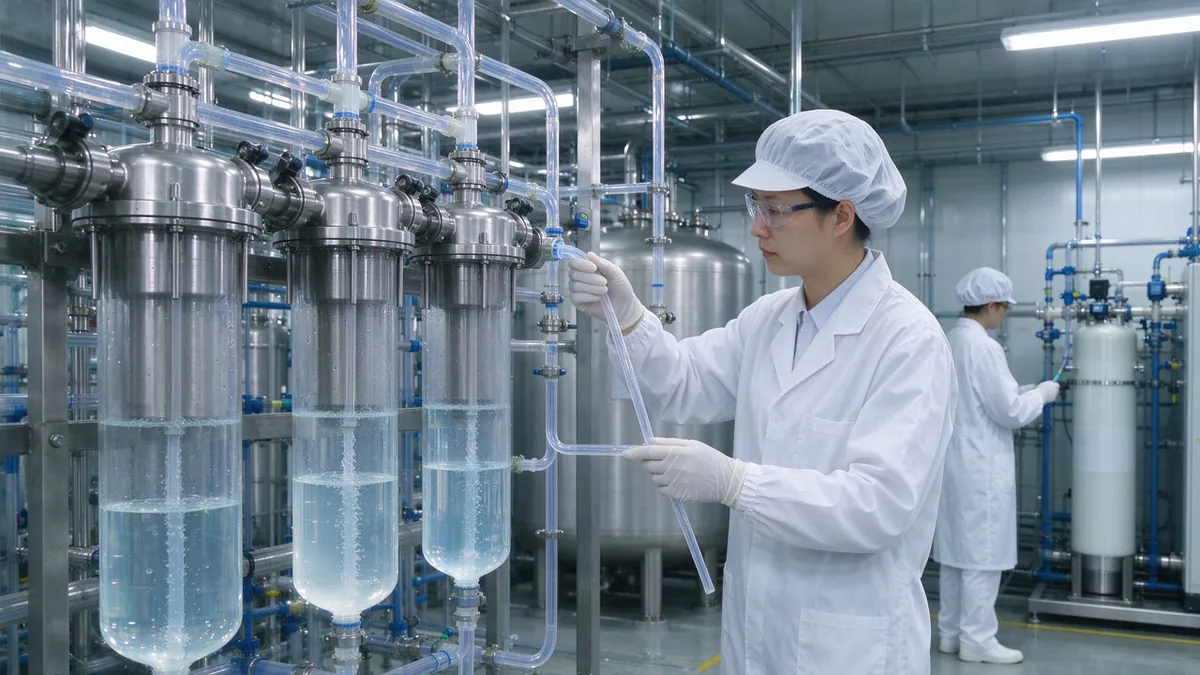
Purified Water in Cosmetic Manufacturing: Why the Water System Decides Quality
Ask a brand to list the ingredients in a body lotion and water will appear first. In emulsions, toners, gels, shampoos, masks and mists it is frequently the largest single component by mass, and yet it receives a fraction of the attention given to the actives. Water quality is one of the few inputs that affects stability, microbial safety, colour and odour simultaneously, which makes the treatment system a genuine quality control point rather than a background utility.
What Purified Water Means in Practice
Cosmetic manufacturing does not require the highly refined grades used in injectable pharmaceuticals, but it does require water that is controlled and documented. In practice the specification covers three families of parameters:
- Chemical and ionic. Conductivity and total dissolved solids, plus hardness and specific ions such as iron and manganese that can catalyse oxidation and discolour a product.
- Organic. Total organic carbon, a proxy for dissolved organic contamination that can feed microorganisms.
- Microbiological. Total viable count and absence of specified organisms, with limits set by the manufacturer's own specification and monitored on a defined frequency.
The Treatment Train
A typical system for a cosmetic plant is a sequence of stages, each removing what the previous one cannot.
Pre-treatment
Multimedia filtration removes suspended solids, activated carbon removes chlorine and organics, and a softener exchanges calcium and magnesium for sodium. Chlorine removal is not optional: it protects the downstream membranes and prevents the formation of chlorinated by-products. Softening protects the reverse osmosis membranes from scaling and reduces the hardness load in the finished water.
Reverse Osmosis
RO is the workhorse. Water is forced through a semi-permeable membrane that rejects the great majority of dissolved ions, organics and microorganisms. Recovery, the proportion of feed water that becomes product, is a trade-off between yield and membrane life. Concentrate handling and the reject stream also need a plan, both for cost and for compliance.
Polishing
Depending on the specification, the RO permeate passes through electrodeionisation or mixed-bed deionisation for further ionic removal, then ultraviolet irradiation at a wavelength that inactivates microorganisms, and sometimes ozonation or ultrafiltration. Ultraviolet also destroys residual ozone, so the order of stages matters.
Storage and Distribution
This is where most systems fail. Treated water held in a stagnant tank is a culture medium. A well-designed distribution loop circulates continuously, keeps the water moving at a velocity that discourages attachment, uses sanitary fittings and diaphragm valves with no dead legs, and returns to the tank through a return leg that prevents stagnation. Materials matter too: stainless steel or appropriate plastics, with no crevices and no old gaskets.
Biofilm: The Problem That Returns
Microorganisms do not float freely as often as they attach. Once a biofilm forms on a pipe wall or a valve seat, it protects the community from sanitisation, sheds cells intermittently and produces results that fluctuate without an obvious cause. Sampling can miss it because the biofilm releases cells unevenly. Countermeasures are structural and procedural: loop design with no dead legs, regular sanitisation, and a sampling programme that includes routine points and not only the outlet. Hot water sanitisation at a defined temperature and duration is the most common method; chemical sanitisation is used where the loop materials permit.
Monitoring That Actually Detects Drift
A monitoring plan should be written before the system is commissioned, not assembled from whatever the first reports happen to contain.
- Conductivity and TOC continuously at the outlet and at defined use points.
- Microbial counts on a fixed frequency, with trending rather than pass or fail against a single limit. A count that doubles over three months is a signal even if it remains inside specification.
- Water hardness and chlorine after pre-treatment, since a failure there damages membranes invisibly.
- Membrane performance tracked as permeate conductivity and pressure differential across the element.
- Sanitisation records with temperature, duration and the operator, forming part of the batch documentation for products made with that water.
Why Water Quality Reaches the Formula
Three effects appear regularly when water quality drifts. Ionic content alters the pH and buffering of a formula, which shifts preservative performance and can destabilise an emulsion. Trace iron and copper accelerate oxidation, shortening shelf life and producing colour change in products containing unsaturated oils or certain actives. And a raised microbial load consumes preservative capacity before the product ever reaches a consumer, which shows up later in a challenge test that passes on development batches and fails on production ones. The last case is particularly expensive because the formula is often blamed when the water is the cause.
Documentation Under GMP
An ISO 22716 or comparable GMP inspection will look at the water system closely, because it is a shared input to every batch. Expect to be asked for the system description and schematic, the validated specification, the monitoring schedule and results, the sanitisation programme and records, and the corrective action procedure when a result exceeds a limit. A system without a schematic and a written monitoring plan is difficult to defend, even when the water is good.
What to Ask a Manufacturer
The questions are simple and the answers are revealing. What is the treatment train? Is the loop continuously circulated, and what is the return velocity? How is sanitisation performed and how often? How frequently is water tested, and where are the sample points? Can I see the last three months of trending data? A factory producing under ISO 22716 and GMP controls will answer all of these without preparation. OEM COSMETICS ODM operates a documented purified water system with continuous circulation, scheduled sanitisation and trended monitoring, and includes water quality records in the batch documentation provided to brand partners.
Talk to our team: WhatsApp +86 18709713948 · Email adon@oemcosmeticsodm.com · Website www.oemcosmeticsodm.com