
Preservative Selection: Beyond the Challenge Test
A preservative efficacy test tells you whether a system works. It does not tell you which system to choose. That decision has to be made against four inputs that have nothing to do with the test: the pH of the formula, the packaging, the regulatory position of each market, and what the brand wants to say on the label. Treating preservation as a test to pass, rather than a decision to make, is how products end up being reformulated late.
The Four Inputs
- pH. Most preservatives have a pH range in which they are effective, and outside it they lose potency rapidly. Organic acids are the clearest example: their active form only exists below a certain pH, and a formula that drifts upwards during storage quietly loses protection.
- Packaging. A jar is the worst case, because the consumer introduces fingers and the product is exposed each time it is opened. A pump or an airless dispenser is a far better starting position, and a preservative system that is adequate in an airless pack may not be adequate in a jar.
- Regulatory position. Permitted preservatives and their maximum concentrations differ by market. A system acceptable in one region may be restricted in another, and a global launch has to satisfy the strictest market it will be sold in.
- Consumer and marketing position. A brand that wants to market a product as free from a particular preservative has removed that option from the formulator, and the alternatives have their own constraints and sensory effects.
What Broad Spectrum Means
Bacteria, yeasts and moulds have different vulnerabilities, and no single material covers all of them equally at a cosmetic-use level. Most practical systems combine two or three materials with complementary activity, sometimes with a chelating agent to improve performance and a humectant to reduce water activity. The combination approach is standard for a reason, and a single-material system is usually a compromise that works in a narrow set of conditions.
The Challenge Test Confirms, It Does Not Choose
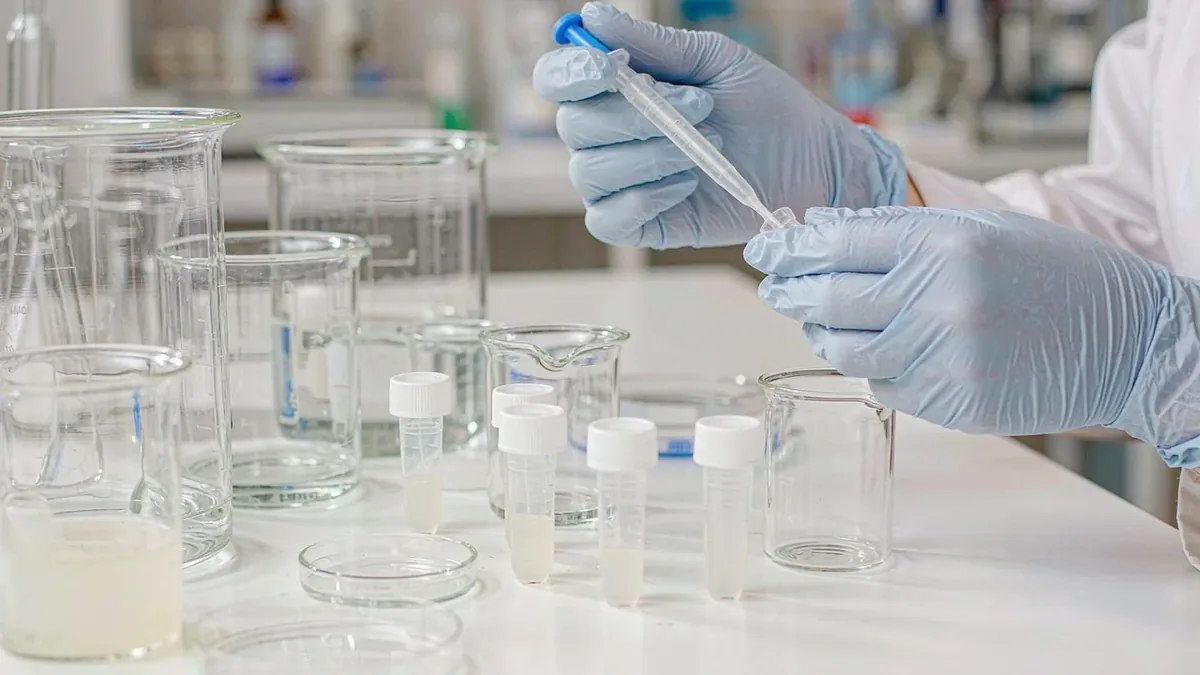
Preservative efficacy testing introduces a defined panel of organisms into the product and measures the reduction over time. It is performed on the final formula in the final pack, because both affect the result. What it cannot do is suggest alternatives. If the system fails, the formulator has to identify why: an ingredient that is reducing activity, a pH that has drifted, a packaging interaction, or simply a level that is too low for the product's risk profile.
The test is also not a one-time event. It should be repeated whenever the formula, the pack or the manufacturing process changes materially, and some brands repeat it periodically on production batches as a surveillance measure.
Natural and Free-From Positions
Removing a widely recognised preservative from consideration narrows the palette considerably, and the alternatives come with trade-offs. Some are effective only in a narrow pH range. Some have a strong odour or colour. Some are more expensive. Some have limited data behind them, which is a real consideration when a brand is making a claim about safety. A natural or free-from position is a legitimate choice, but it should be made with an understanding of what it costs in formulation flexibility, not as an afterthought.
Sensory and Stability Effects
Preservatives are not inert. Some affect viscosity, particularly in systems where the preservative interacts with a thickener. Some discolour over time, especially in the presence of certain actives or packaging materials. Some have a detectable odour that the fragrance has to mask. And some are absorbed by plastic packaging, which reduces their effective concentration. All of these appear during stability and compatibility work, which is why preservation cannot be finalised until the pack is known.
Risk Profile of the Product
Not every product carries the same risk. A dry powder, an anhydrous balm and a product packaged in a self-preserving format have different requirements from an aqueous emulsion in a jar. Products intended for the eye area, for children or for use on broken skin attract stricter expectations. The preservative system should be proportionate to the risk, and a brand that under-protects a high-risk product to save cost is making a poor trade.
Practical Sequence
The useful sequence is: fix the pack and the market first, understand the pH the formula will sit at, choose candidate systems that satisfy the regulatory and marketing constraints, then test. A formulator who is given the pack and the pH can propose two or three systems with a high chance of success. A formulator who is given none of that will propose something that has to be redone.
OEM COSMETICS ODM designs preservative systems against the pack, the pH and the destination market, confirms them through challenge testing on the final formula in the final pack, and documents the rationale in the product dossier under ISO 22716 and GMP systems.
Talk to our team: WhatsApp +86 18709713948 · Email adon@oemcosmeticsodm.com · Website www.oemcosmeticsodm.com