"Why is your MOQ 1,000 when I only want 300?" It is a fair question, and the honest answer has nothing to do with unwillingness. It is about how a filling line actually works.
Key takeaways
- MOQ is driven mainly by line setup and cleaning time, not by greed. A batch that takes 20 minutes to fill still takes 2 hours to set up and clean.
- Unit cost typically drops 25 – 40% between 500 and 5,000 units — but most of that drop comes from packaging, not formula.
- The real constraint at low volume is usually packaging supplier MOQ (often 5,000 – 10,000 pieces), not the factory's.
- Three ways to cut your effective MOQ: use stock packaging, consolidate SKUs on one base formula, or share a production run.
What actually creates a minimum order quantity
1. Line setup and cleaning
Before a single bottle is filled, the line is disassembled, sanitised and reassembled. After the run, it is cleaned again and the cleaning is verified. That fixed labour cost — often 2 to 4 hours of technician time plus downtime — is identical whether you fill 200 units or 20,000. Spread over 200 units it adds dollars per piece; spread over 20,000 it adds cents.
2. Bulk batch minimum
Emulsions are made in vessels with a practical minimum volume (commonly 50 – 500 kg depending on the equipment). You cannot meaningfully make 3 kg of cream in a 500 kg vacuum homogeniser — the shear, heating and cooling profiles simply do not scale down. Below the vessel minimum you either pay for a small pilot vessel (slower, more expensive per kg) or accept surplus bulk.
3. Raw material purchase minimums
Active ingredients, preservatives and specialty emulsifiers are bought from chemical suppliers in drums and cartons. A specialty peptide may only be available in 5 kg packs. If your formula needs 200 g, the rest sits in inventory — which the factory prices into your unit cost or declines to run.
4. Packaging supplier MOQ — the real bottleneck
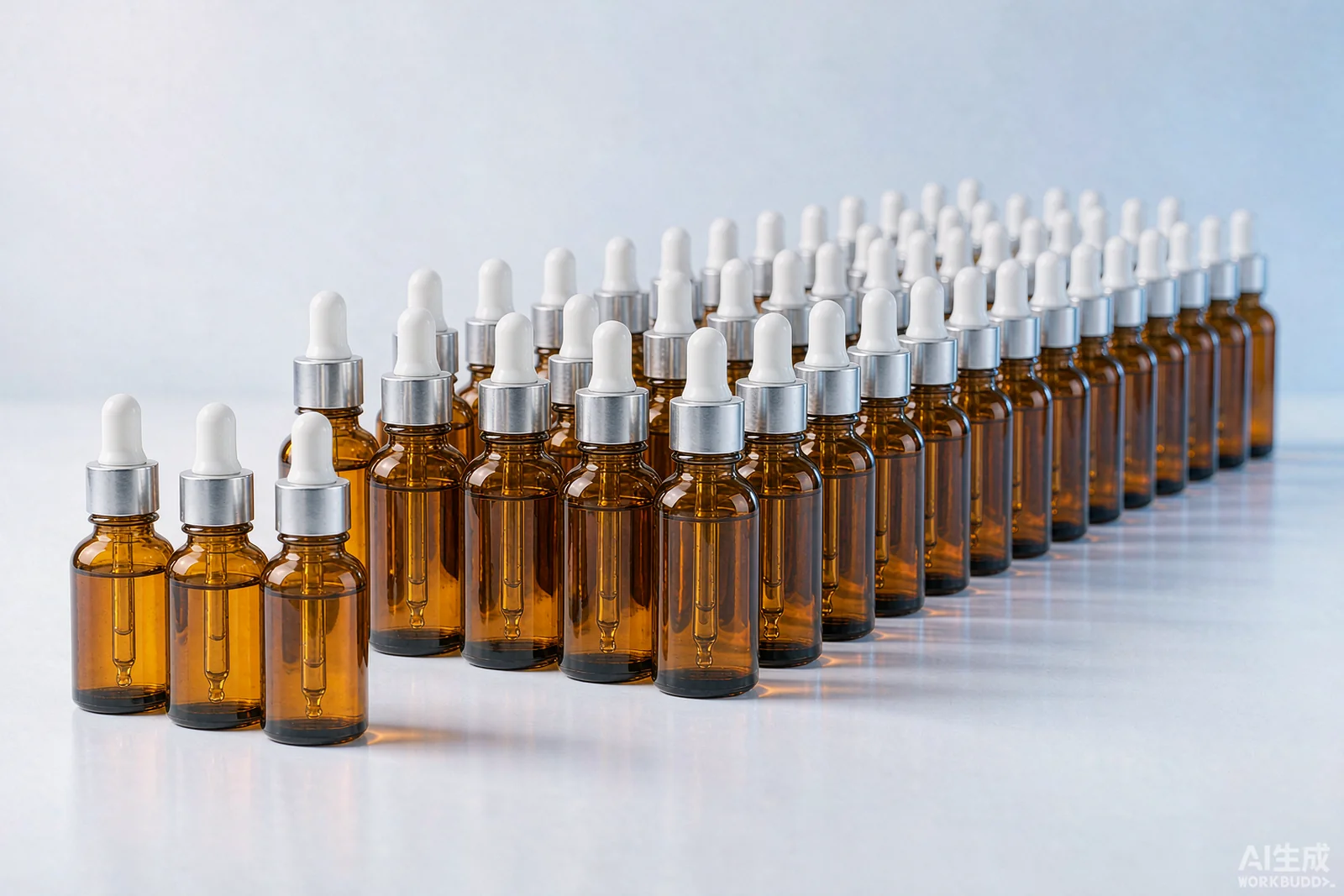
This is the one that surprises brand owners. A custom-moulded bottle may carry a 10,000-piece minimum from the packaging maker; a printed box often 1,000 – 3,000. Your cosmetic factory might happily fill 500 units, but it cannot buy 500 bottles. Choosing stock packaging is usually the single most effective way to lower your real MOQ.
What the tiers actually cost
Indicative figures for a mid-tier 30 ml serum with stock packaging, to illustrate the shape of the curve rather than to quote a price:
| Cost element | 500 units | 1,000 units | 5,000 units |
|---|---|---|---|
| Formula / bulk (per unit) | US$1.30 | US$1.05 | US$0.82 |
| Primary packaging (per unit) | US$1.85 | US$1.55 | US$1.10 |
| Secondary packaging (per unit) | US$0.60 | US$0.45 | US$0.28 |
| Filling & assembly labour (per unit) | US$0.75 | US$0.42 | US$0.18 |
| Line setup (amortised) | US$0.80 | US$0.40 | US$0.08 |
| QC & documentation (amortised) | US$1.60 | US$0.80 | US$0.16 |
| Landed unit cost | US$6.90 | US$4.67 | US$2.62 |
| Total order value | US$3,450 | US$4,670 | US$13,100 |
| Implied retail at 5x markup | US$34.50 | US$23.35 | US$13.10 |
Note the shape: going from 500 to 1,000 units halves your fixed-cost burden per unit. That is why the jump from 500 to 1,000 is usually the best-value decision a new brand can make — the total cash outlay rises only about 35% while unit cost falls 32%.
Hidden surcharges to ask about before you sign
- Small-run surcharge — many factories add 15 – 40% below their standard MOQ.
- Surplus bulk charge — if the vessel minimum exceeds your requirement, you may be billed for the full batch or for disposal.
- Plate and screen charges — one-off printing setup, typically US$80 – US$300 per colour per artwork.
- Sample and courier fees — usually credited back against your first order; ask if they are.
- Testing fees — fixed per formula, not per unit. At 500 units they can add US$1.50+ per piece.
Four legitimate ways to lower your MOQ
- Use stock packaging. Removes the packaging supplier's 5,000 – 10,000 piece minimum instantly.
- Build SKUs on one base formula. A cleanser, a cream and a lotion sharing a base can often be filled in one run with one setup.
- Reduce colour and fragrance variants. Each variant is technically a separate production run with its own setup.
- Accept a higher unit price for run one. Most factories will take a lower first order at a premium if you commit to a second run — ask for it explicitly.
What not to do
Do not push your manufacturer to skip or shorten stability testing to hit a lower MOQ or faster date. Testing cost is fixed regardless of batch size, which is exactly why small brands feel tempted to skip it — and exactly why small brands are the ones that get hurt when a cream separates on a customer's shelf.
Frequently asked questions
Why is the MOQ per SKU and not for the whole order?
Because each SKU is a separate filling run with its own setup, cleaning, bulk batch and QC. Five SKUs at 200 units each is more factory work than one SKU at 1,000 units, which is why per-SKU minimums exist.
Can I order 200 units for a market test?
Yes, but expect to pay 40 – 80% above the 1,000-unit price, and expect the factory to require the full bulk batch. It is legitimate for validating demand and gathering reviews, not for making margin.
Does a higher MOQ always mean a better unit price?
Up to roughly 10,000 units, yes, with diminishing returns. Beyond that, savings come mostly from packaging purchased directly and from better raw material contracts rather than from the filling process.
Do MOQs differ by product type?
Yes. Simple anhydrous products (balms, oils) and single-phase products (toners, micellar water) often have lower minimums than complex emulsions, because they need less equipment time and shorter processing. Sheet masks, which are packed rather than filled, usually carry higher minimums set by the film and sachet supplier.
Ready to Develop Your Own Skincare Line?
Guangzhou Laiyue Biological Group is a skincare OEM / ODM and private label manufacturer operating from Guangzhou, China. We maintain a library of more than 10,000 mature formulas, hold 50+ formulation patents, and ship to brand owners in 60+ countries.
Our team handles the entire chain for you: formula development or matching, stability and compatibility testing, regulatory documentation (CPNP, MoCRA, ISO 22716), filling, packaging sourcing and export paperwork — so you can put your budget into brand building and distribution.
Tell us what you want to make and we will come back with a formulation proposal, MOQ options and a factory-direct quote within 48 hours.
- WhatsApp (fastest): +86 187 0971 3948
- Email: laiyue001@gmail.com
- Send a requirement brief: https://oemcosmeticsodm.com/contact.php
No obligation, and we sign an NDA before you share any formula or brand detail.