
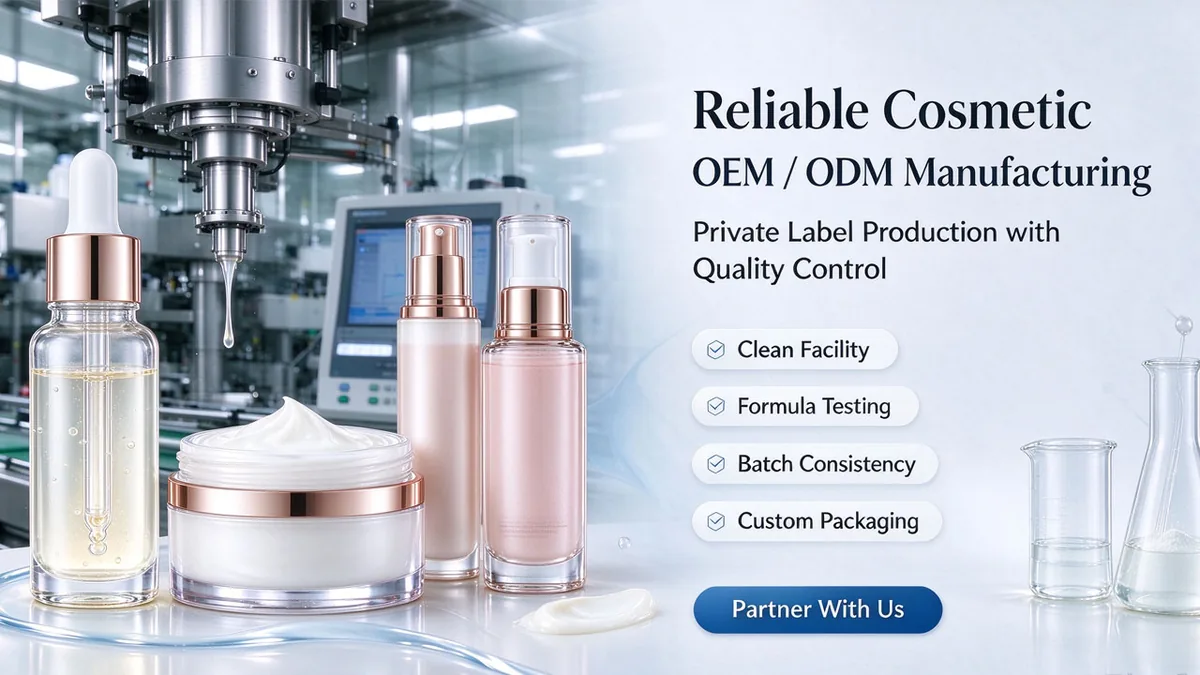
Quality Control in Cosmetic Manufacturing: AQL and Batch Records
Brands usually evaluate a manufacturer by the samples they receive. Samples come from a pilot run, supervised closely and made in small quantities. Production runs are a different activity, and the gap between the two is where quality problems appear. What closes that gap is not better intentions but a defined set of checks and a record that shows they were performed.
In-Process Control: Checking During Production, Not After
The principle is that a defect should be caught at the stage that creates it, while the batch can still be corrected. On a typical emulsion line the checkpoints run like this:
- Raw material receipt. Identity confirmation against the specification, certificate of analysis review, and microbiological testing on high risk materials before release to production.
- Water system. Conductivity and microbiological testing on a defined schedule. This is the checkpoint most often skipped and the one most often responsible for a contaminated batch.
- Phase preparation. Temperature and time recorded for each phase, with verification that the oil and water phases reached the specified temperature before emulsification.
- Emulsification and homogenisation. Speed, time and temperature recorded. Particle size or microscopy check where the product specification requires it.
- Cool down and addition. Temperature at the point of adding heat sensitive ingredients, since adding an active above its tolerance destroys it silently. This is a frequent cause of a batch that assays low.
- Bulk adjustment. pH, viscosity, appearance and odour checked against specification, with an adjustment step if a parameter is out.
- Filling. Fill weight checked at defined intervals, seal or torque checked, and a first article inspection at the start of the run.
- Packing. Label verification against the approved artwork, including the batch code and the expiry date, before the carton is closed.
Each of these produces a recorded result. The value is not the individual measurement but the pattern: a pH that drifts across a batch, or fill weights that trend downward over a shift, are detectable from the records before they become a customer complaint.
AQL Sampling and What It Actually Means
Acceptable quality level inspection is the standard method for deciding whether to accept a finished lot based on a sample. The procedure is defined by international standards that specify the sample size and the accept and reject numbers for a given lot size and AQL level.
The common misunderstanding is what the number means. An AQL of 1.0 per cent does not mean the lot contains 1 per cent defects. It means that if the true defect rate were at that level, the sampling plan would accept the lot a high proportion of the time. AQL is a decision rule, not a measurement of the lot, and its protection is asymmetric: it accepts a lot with a defect rate near the AQL most of the time, and rejects a lot with a substantially worse rate.
In practice, cosmetic inspection distinguishes critical, major and minor defects. A critical defect is a safety or regulatory issue, such as a missing ingredient on the label or a leaking container. A major defect affects function or appearance noticeably. A minor defect is a cosmetic imperfection. Different AQL levels apply to each class, with critical defects set at zero tolerance in most programmes.
The Batch Record Is the Product's History
A batch record is the document set that allows a specific unit to be reconstructed months or years later. It should contain the approved formula and process instructions, the actual quantities weighed for that batch, the recorded in-process results, the equipment used and its cleaning status, the filling and packing records, the batch code assigned, the yield achieved, and the release decision with the name of the person who made it.
Three properties make a batch record useful. It must be contemporaneous, recorded as it happens rather than reconstructed afterwards. It must be complete, with no gaps that a reviewer has to infer. And it must be traceable, linking the batch code on the pack to the raw material batches used, so that an issue with a raw material can be traced forward to every affected finished product.
Yield is worth highlighting. A batch that yields 96 per cent of theory is normal. A batch that yields 88 per cent suggests losses somewhere, and the number on its own is a useful trigger for investigation. It is one of the simplest indicators of process control available.
What a Brand Should Ask For
Three things are reasonable to request, and a manufacturer operating a controlled process will supply them without hesitation:
- A certificate of analysis for the finished batch covering appearance, odour, pH, viscosity, microbiological results and any assay on a declared active.
- The batch code and the production date, which should match what is printed on the pack, so that a complaint can be linked to a record.
- A retained sample. The manufacturer should keep one; the brand should also keep at least one retail unit of each batch for the shelf life plus a margin. It is the only way to investigate a complaint eighteen months later.
For a first order, requesting a summary of the testing schedule and the release criteria at the quotation stage tells you more about the operation than any factory tour. A manufacturer that tests every batch against documented criteria and can show the schedule is a different proposition from one that inspects when a customer complains.
Where Quality Problems Usually Come From
Across the projects we handle, the recurring causes are not individual operator errors. They are a change made without notification. A raw material is substituted because a supplier ran out. A fragrance is replaced with a close match. A component is changed because the original is unavailable. Each of these can be invisible in the finished product at first and clearly wrong three months later.
The control that prevents it is a change control procedure with a notification obligation to the brand. Anything affecting the formula, the raw material source, the pack or the process should trigger a notification and, where relevant, a re-validation. That clause in the supply agreement does more to protect a brand's reputation than any inspection regime.
Documented Quality Control on Certified Lines
OEM COSMETICS ODM operates in-process controls with recorded results at every stage, AQL based finished goods inspection with critical, major and minor classification, and full batch records linking each unit to its raw material batches, on ISO 22716 and GMP certified lines. Request the testing schedule and a sample batch record with your quotation.
Talk to our team: WhatsApp +86 18709713948 · Email adon@oemcosmeticsodm.com · Website www.oemcosmeticsodm.com