
Powder Cosmetic Products: Blending, Filling and Dust Control
Powder products look like the easy end of cosmetic manufacturing. There is no emulsification, no pH to control and, in a genuinely anhydrous product, no water activity to support microbial growth. In practice the manufacturing challenges are simply different ones, and the equipment and controls are not the same as those used for liquids.
What Counts as a Powder Product
The category is broader than it first appears. Loose powders such as setting powder, blush and mineral foundation. Pressed powders where the blend is compacted into a pan. Dry shampoos and dry texturising sprays, where a powder blend is delivered from an aerosol or a pump. Powder masks and cleansers. Bath salts and bath powders. Body powders and foot powders. Each shares the same core operations of blending, sieving and filling, with compaction added for pressed formats.
Blending
Blending is where uniformity is won or lost. Powder blenders come in several designs, and the choice matters to the result.
- Ribbon blenders are common for larger volumes and handle a wide range of bulk densities. They are efficient but can be difficult to clean, and they can cause attrition in fragile ingredients.
- V-blenders and double cone blenders are gentler and are often preferred where particle integrity matters. They handle smaller volumes well.
- High shear mixers are used when a pigment has to be broken down or a binder dispersed, but the heat and energy they introduce can be a problem for waxy or heat-sensitive components.
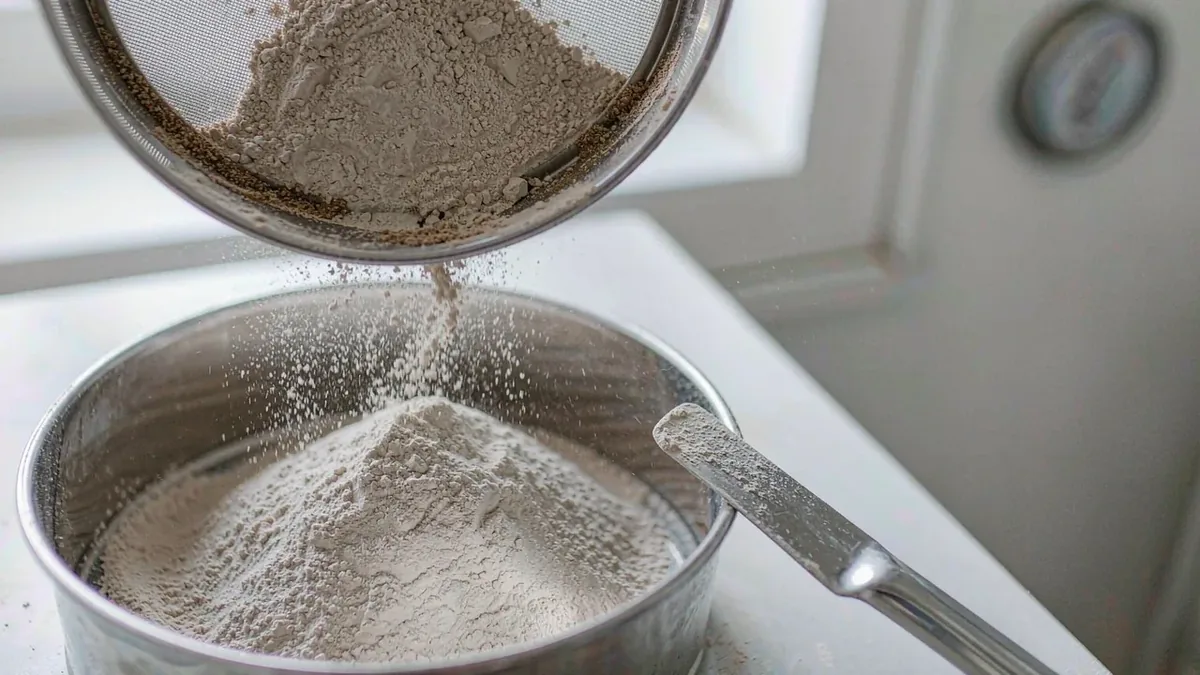
Order of addition is not arbitrary. Pigments are usually dispersed into a portion of the base before the remaining bulk is added, so the pigment sees a high enough concentration to break up agglomerates. Fragrance is added late and blended gently, because excessive mixing volatilises it. Sieving between stages breaks up lumps and removes oversize material, and the sieve mesh is a specification rather than a convenience.
Segregation and Uniformity
Blended powders do not stay blended if the particle sizes or densities differ. Vibration during transfer, free fall into a filling hopper, and even settling in storage all allow finer or denser particles to separate. The result is a shade that varies between the first and last units of a run, or a product that performs differently depending on where in the jar it was taken from.
Control comes from several directions: matching particle size distributions between components where possible, minimising free fall and transfer steps, avoiding over-long storage in hoppers, and verifying uniformity by sampling from multiple points in the batch and, where relevant, at the beginning, middle and end of the fill run. For shade-critical products the check should be a colour measurement against a standard, not a visual comparison under whatever light happens to be available.
Moisture and Caking
Anhydrous does not mean water-free. Powders take up moisture from the air, and small amounts cause caking, poor flow and, in pressed products, cracking. Controls include a dehumidified production and storage environment, sealed containers during storage between operations, minimal exposure during filling, and specifications on the moisture content of incoming raw materials. A powder blend held over a humid weekend in an open hopper is a different material on Monday.
Pressing and Compaction
Pressed products add mechanical complexity. The blend is dosed into a pan and compressed under a defined pressure, usually with a binder to hold it together and a lubricant to prevent sticking. Pressure that is too low gives a soft pan that crumbles in the compact; too high gives a hard surface that picks up poorly and glazes over. Pressing is also where shade can shift, because compression changes how light interacts with the surface. Reproducing the approved press sample therefore depends on pressing pressure, dwell time, pan type and the blend's flow properties, all of which should be recorded as process parameters rather than left to an operator's feel.
Filling
Powder filling is either volumetric, auger based, or gravimetric. Volumetric filling is fast but sensitive to density variation; auger filling gives better accuracy where flow is consistent; gravimetric filling is the most accurate and the slowest and is often used for premium products. Whichever is used, the fill weight must be verified across the run and not only at the start, because density in the hopper changes as the level falls.
Dust Control and Operator Safety
Airborne cosmetic powder is an occupational exposure, not just an untidiness problem. Fine particulate can be inhaled, and many cosmetic powders are fine enough to remain suspended. The correct controls are engineering-led: local exhaust ventilation at the point of transfer and filling, enclosed transfer where possible, and filtration appropriate to the particle size. Respiratory protection is the last line of defence, not the first.
There is also an explosion risk to assess. Fine organic powders suspended in air can form an explosive atmosphere, and a dust hazard assessment should be part of the plant's safety documentation. It determines which equipment is acceptable, what bonding and grounding is needed, and which housekeeping regime is required, because accumulated dust on surfaces is as much a hazard as airborne dust.
Microbiological Considerations
Anhydrous powders do not support microbial growth, but that does not make microbiology irrelevant. Raw materials can carry a bioburden, particularly plant-derived powders, and where a product is intended for use near the eyes or on broken skin the incoming specification matters. The controls are a raw material specification, supplier monitoring, and in some cases an irradiation or heat treatment step on the ingredient before blending. Prevention is far simpler than remediation.
Packaging and Stability
Moisture protection continues into the pack. Sifter jars, sifter closures with a protective seal, and jars with a tight, well-fitted lid all matter more than they do for a liquid. For dry shampoos delivered as an aerosol, the propellant and the powder must be compatible and the valve must not clog over the life of the can. Compatibility and stability work on powder products should include a period of storage at elevated humidity for the finished pack, not only at ambient.
Where to Start
Powder projects succeed when they are planned as powder projects rather than as a variation on liquids. OEM COSMETICS ODM manufactures loose and pressed powder products with dedicated blending, sieving and filling equipment, controlled humidity in the production and storage areas, and a documented dust risk assessment, and produces under ISO 22716 and GMP systems so the batch record shows the uniformity and fill checks a brand needs if a retailer ever asks.
Talk to our team: WhatsApp +86 18709713948 · Email adon@oemcosmeticsodm.com · Website www.oemcosmeticsodm.com