
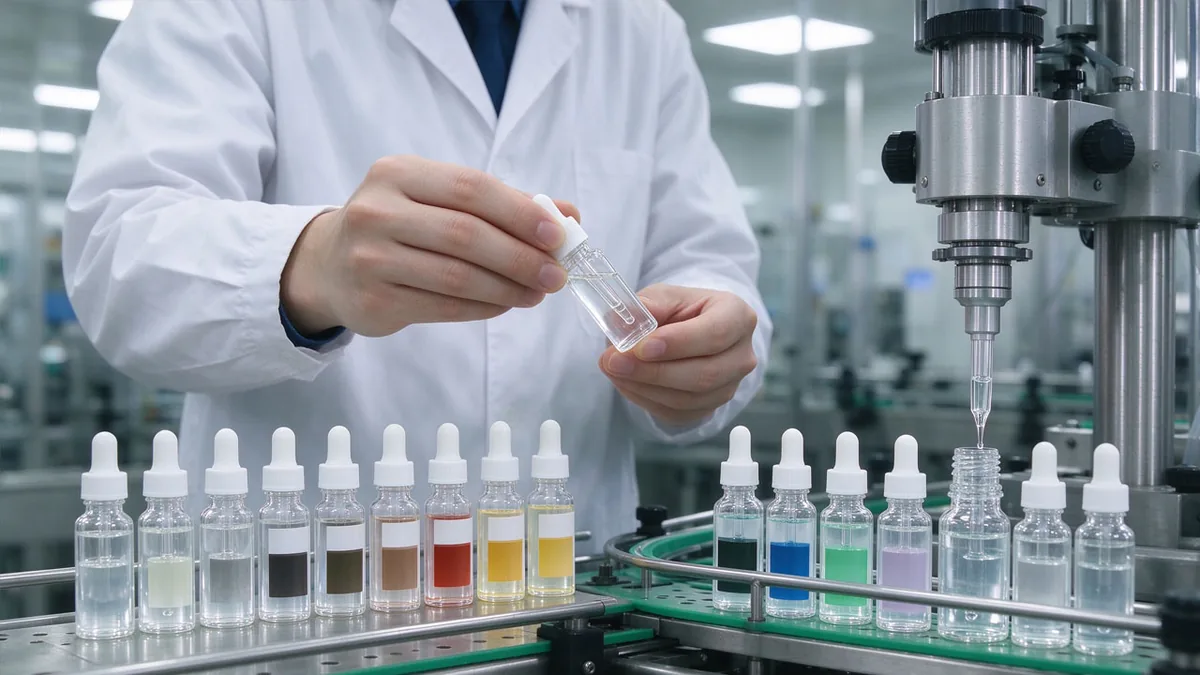
Face Mist and Hydrating Spray Manufacturing
Face mist is the most forgiving product to formulate and the least forgiving to package. The liquid is nearly always simple: water, humectants and a small amount of active. The consumer experience, however, is entirely determined by how the product leaves the nozzle, and a mist with a poor spray pattern feels cheap regardless of what is in it. Getting the format right is a packaging and compatibility exercise more than a chemistry one.
What Makes a Good Mist
Four characteristics define the experience, and all four are decided by the interaction between the formula and the dispensing system:
- Droplet size. Fine enough to land as a mist rather than as visible droplets. Droplet size is set by the nozzle orifice, the pump pressure and the viscosity of the liquid.
- Pattern consistency. An even, circular pattern across the face rather than a cone that concentrates in the middle. This is a function of nozzle geometry and of the actuator design.
- No spitting. A coarse burst at the start or end of the stroke. Usually caused by a pump that does not prime fully or by air entering the dip tube.
- Wetness. How much liquid lands per stroke. Too much and the face is soaked, which consumers describe as the product running. Typically 0.1 to 0.2 millilitres per stroke is the comfortable range.
Formulating for Sprayability
Viscosity is the variable the formulator controls, and it has to be low. Most mists sit below 50 centipoise; above roughly 100 the spray becomes coarse and intermittent. That rules out most conventional thickeners and means the formula has no structuring system at all, which in turn affects how the actives and the fragrance behave.
The consequence is that a mist cannot suspend anything. Insoluble actives, oils at any meaningful level and particulate ingredients will either separate or clog the nozzle. Where an oil is essential for the sensory effect, it must be solubilised, and the solubiliser itself increases viscosity and can affect the spray.
Alcohol content is another consideration. A mist with a substantial alcohol level sprays finely and dries quickly, but it stings on sensitive skin and around the eyes. A mist without alcohol is gentler and needs a slightly different pump setting to achieve the same droplet size.
Preservation Is More Restrictive Than Expected
A mist is essentially water, which makes it the most attractive possible environment for microbial growth, and it is applied to the whole face including near the eyes. The combination tightens the microbiological criteria and narrows the preservative options.
The additional complication is that preservatives often have a noticeable odour or a taste when the product drifts onto the lips, which happens with a face mist in normal use. Selection therefore has to consider the sensory impact, not only the efficacy. Some of the most effective systems are the ones with the strongest smell, and this is a genuine trade-off rather than a simple optimisation.
Anhydrous or very low water mists sidestep the problem, but they are a different product category. For a conventional water based mist, challenge testing on the finished formula is mandatory and the mould result is the one to watch.
Container Compatibility and the Failure Modes
The pump or valve interacts with the formula in ways that show up over months:
- Elastomer swelling. Alcohol, fragrance components and some solvents cause the seals and the dip tube to swell or harden. A pump that works on day one may leak or deliver a poor spray after three months. Compatibility testing with the actual pump is not optional.
- Corrosion of metal components. Spring steel inside a pump and any aluminium part in contact with an acidic or salty formula can corrode, producing discolouration and eventually failure. Where the formula is acidic, specify a pump with a plastic spring or a protective coating.
- Clogging. A formula with any suspended material, or one that dries at the orifice, will eventually block. A fine mist with a volatile component dries fastest at the nozzle, which is why some mists need a wipe or a purge stroke. Reducing solids and choosing a slightly larger orifice reduces the risk.
- Weight loss over time. Water diffuses through plastic walls. In a 100 millilitre mist over two years, the loss can be several per cent, which is enough to affect the declared net content. A barrier layer in the bottle or a shorter shelf life addresses it.
Aerosol or Non-Aerosol
Aerosol mists using a propellant give the finest and most consistent spray, and they carry the safety classification and filling requirements that come with aerosols. Many cosmetic factories do not operate aerosol lines and will outsource that step, which affects the lead time and the minimum order quantity. The propellant also interacts with the formula, and a product that is pleasant as a non-aerosol can behave differently when pressurised.
Non-aerosol pump sprays and bag-on-valve systems cover most of the market. Bag-on-valve gives a continuous spray without propellant in the product, dispenses in any orientation and keeps the formula separated from the propellant gas, which is the cleaner solution for a sensitive skin product. It costs more and requires a filling partner equipped for it.
Testing the Spray, Not Just the Formula
The stability programme needs to cover the spray performance, not only the liquid. Useful checks include droplet size distribution measured at the start and after storage, spray rate in millilitres per second, pattern photographs under standard lighting, and a priming stroke count. A formula that passes all its chemical tests and sprays unevenly after three months is a defective product.
Testing at two temperatures matters here more than in most categories, because viscosity changes with temperature change the spray. A mist that sprays well at 25 degrees Celsius and coarsely at 10 degrees Celsius will generate complaints from customers in cold climates.
What Sells in This Category
Mists succeed on immediate sensory feedback and on convenience rather than on a long term result. Position around refreshment, hydration through the day, setting makeup, and a comfortable feel on skin. Claims about rebuilding the barrier or repairing the skin are hard to support for a product whose contact time is seconds. Ingredients that deliver an immediate sensation, such as a cooling agent or a light humectant film, do more for repeat purchase than a sophisticated active whose exposure time is too short to matter.
Mists Developed With the Pump Qualified
OEM COSMETICS ODM produces face mists, hydrating sprays, setting sprays and toners on ISO 22716 and GMP certified lines, with pump and valve compatibility testing, droplet size and spray pattern checks at both temperature extremes and challenge testing on the finished formula. Send us the sensory effect you want and we will match the dispensing system to it.
Talk to our team: WhatsApp +86 18709713948 · Email adon@oemcosmeticsodm.com · Website www.oemcosmeticsodm.com