
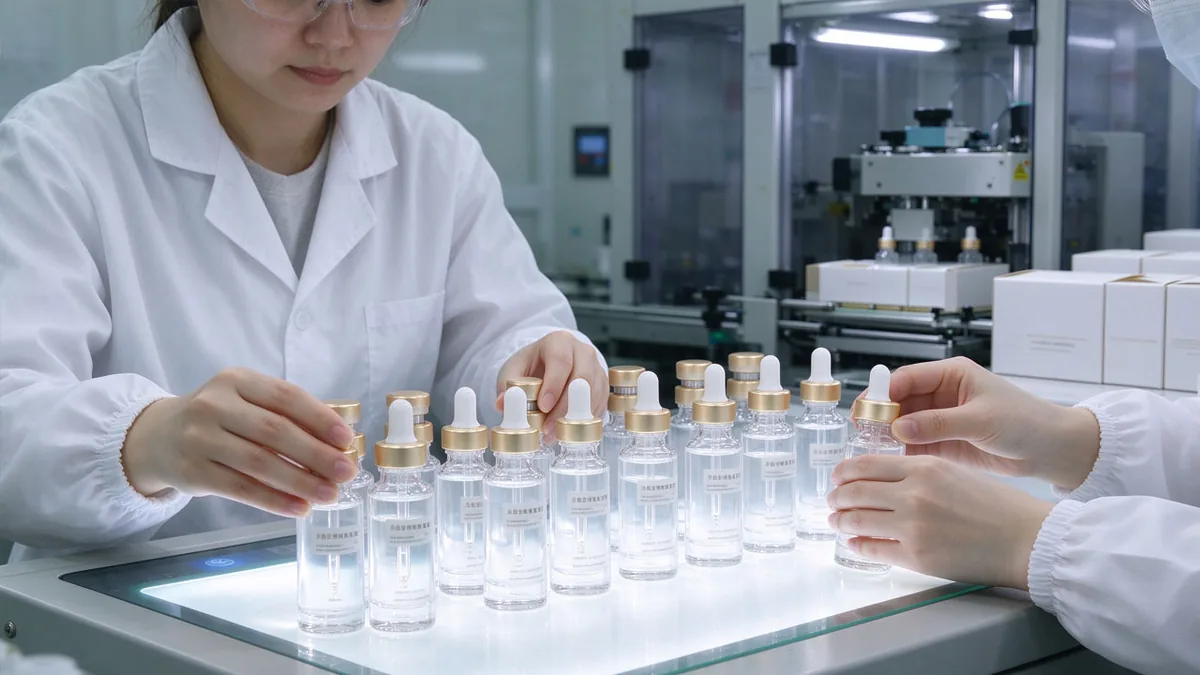
Choosing Where to Manufacture: China, Korea, EU or Domestic
Most brands settle the manufacturing country early and then treat it as fixed, which is a mistake because it is one of the few decisions that cannot be reversed cheaply later. Reformulating for a different country means a new safety assessment, new stability work, new artwork and often a new minimum order commitment. Comparing the options on the factors that genuinely differ makes the choice deliberate rather than incidental.
The Factors That Actually Differentiate
Six variables matter, and they do not point in the same direction:
- Unit cost. China is generally the lowest for volume production, with Korea higher and Europe or North America higher again. The gap narrows considerably at small volumes, because the fixed costs dominate.
- Minimum order quantity. China commonly offers lower minimums than Europe for large volume products, and higher minimums for anything requiring tooling. Korean manufacturers frequently set higher minimums than Chinese ones because their capacity is tighter and their domestic brands fill it.
- Lead time. Domestic manufacturing is fastest, days to weeks rather than weeks to months. China is typically eight to sixteen weeks depending on the pack. Korea sits between.
- Innovation and trend responsiveness. Korea leads on texture, format and packaging trends, and Korean manufacturers often have newer base formulas available off the shelf. China has improved considerably and is competitive on formulation capability, with a strong position in cost-efficient execution.
- Regulatory access. A manufacturer in the target market simplifies registration and reduces the documentation burden. Manufacturing in the EU for the EU market removes the responsible person complexity. Manufacturing in China for the EU or US market adds documentation and a testing burden but is entirely manageable.
- Flexibility on small runs and changes. Domestic and nearby manufacturing generally allows smaller runs, faster changes and more willingness to experiment. Long distance manufacturing rewards specification discipline and punishes indecision.
China: Cost and Capability at Volume
China is where most private label cosmetics in the world are made, for reasons that go beyond cost. The supply chain is complete: packaging components, filling equipment, cap and pump suppliers, printing, cartoning and testing laboratories are all available within a short distance of a manufacturing cluster. That density means a project can be assembled quickly and components can be sourced at prices that would not be achievable with each element imported separately.
Formulation capability has also developed substantially. A factory with an in-house research and development team can develop a custom formula, run sensory trials and produce stability data, and the better facilities hold ISO 22716 certification and are audited by international brands.
The trade-offs are real. Lead time is long, and the sea freight adds another three to five weeks for volume shipments. Communication across a time zone and a language requires a disciplined specification process rather than a conversation. Documentation for regulated markets has to be requested explicitly, because not every manufacturer produces a compliant dossier as a standard deliverable. And the minimum order quantity for a custom pack can be substantial.
Korea: Trend Leadership at a Price
Korea is the source of a large share of the product formats and textures that define current skincare. Manufacturing there gives access to a formulation culture that iterates quickly, and to suppliers who have already developed the textures consumers associate with the category.
Three practical constraints. Minimum order quantities are frequently higher than in China for the same product, and the willingness to run small pilot batches varies. Lead times can be long because domestic demand and export demand compete for the same capacity. And the cost per unit at the volume a new brand can realistically commit to is often substantially higher than the Chinese equivalent, which only works if the brand's positioning supports the retail price that follows.
For a brand whose differentiation is a specific Korean texture or format, the premium can be justified. For a brand selling a generic moisturiser or cleanser, the same product can be made elsewhere at a materially lower cost with no consumer-visible difference.
Europe and North America: Speed and Market Access
Domestic manufacturing wins on three things. Lead time, measured in weeks rather than months. Regulatory simplicity, because the manufacturer is already operating within the destination market's framework and the responsible person question is easier. And flexibility, because a small run or a formula change can be discussed and executed without a long planning cycle.
The cost premium can be substantial, particularly on packaging components, and minimum order quantities in Europe are often higher than a new brand anticipates for a custom pack. For a brand testing a market or running a small premium range, the speed and the ability to iterate can be worth more than the unit cost saving. For a brand scaling to volume, the arithmetic usually points elsewhere.
The Comparison That Actually Decides It
The right question is not which is cheapest per unit, but what the total cost of getting the first profitable production run is, including the cost of time.
- If the brand is testing a concept with an uncertain demand forecast and a limited budget, proximity and flexibility matter more than unit cost, because a smaller first run and faster iteration reduce the risk of committing capital to inventory that does not sell.
- If the brand has a validated product and a distribution channel, unit cost dominates and volume manufacturing becomes the right answer, provided the specification is locked before the first order.
- If the differentiation is the texture or the format itself, the manufacturing origin should follow the capability rather than the price.
- If the destination market is heavily regulated, the documentation capability of the manufacturer matters more than the freight cost, because a non compliant dossier blocks the sale entirely.
Changing Location Later
Brands sometimes plan to start domestic and move to volume manufacturing once demand is proven. That is a sound strategy with one caveat: moving production means reformulating, because two factories will not produce an identical base even from the same brief, and a consumer who notices a change in texture or scent will say so in the reviews.
The mitigation is to treat the first product as a market test rather than as a permanent formula. Keep the technical dossier, the exact composition and the raw material specifications in a form that can be handed to a second manufacturer, and expect the transfer to take three to six months including the new stability and compatibility work. A brand that assumes the move is administrative rather than technical will be caught out.
Questions to Ask Any Manufacturer, Anywhere
- What is your minimum order quantity for this product, and is the figure per SKU or per order?
- What is the realistic lead time from order to goods ready, including raw material procurement?
- Can you supply the composition disclosure, the stability and microbiological data and a GMP statement for a safety assessment?
- What is your process for notifying me of a change to a raw material, a component or the process?
- Who owns the tooling if a custom pack is developed, and under what terms would it be released?
A manufacturer who answers all five with specifics is operating a controlled process. The answers matter more than the location, because the same country contains both excellent and unreliable suppliers, and the difference between them is visible in the documentation rather than in the price.
Manufacturing Support From China at Volume
OEM COSMETICS ODM manufactures skincare, body care and hair care on ISO 22716 and GMP certified lines, with in-house formulation development, low minimum order quantities for standard packs, full composition disclosure and stability and microbiological data supplied as standard project deliverables. Send us your brief and target volume and we will confirm what the first run has to be.
Talk to our team: WhatsApp +86 18709713948 · Email adon@oemcosmeticsodm.com · Website www.oemcosmeticsodm.com